
Arts & Humanities, Ripe for XR
How Christopher Newport University Became a Pioneer in Immersive Learning
Christopher Newport University
Project Snapshot
Institution: Christopher Newport University
Department: Arts & Humanities
Timeline: Lab built within 3–6 months
Budget: Donor-funded (efficient use of a modest allocation)
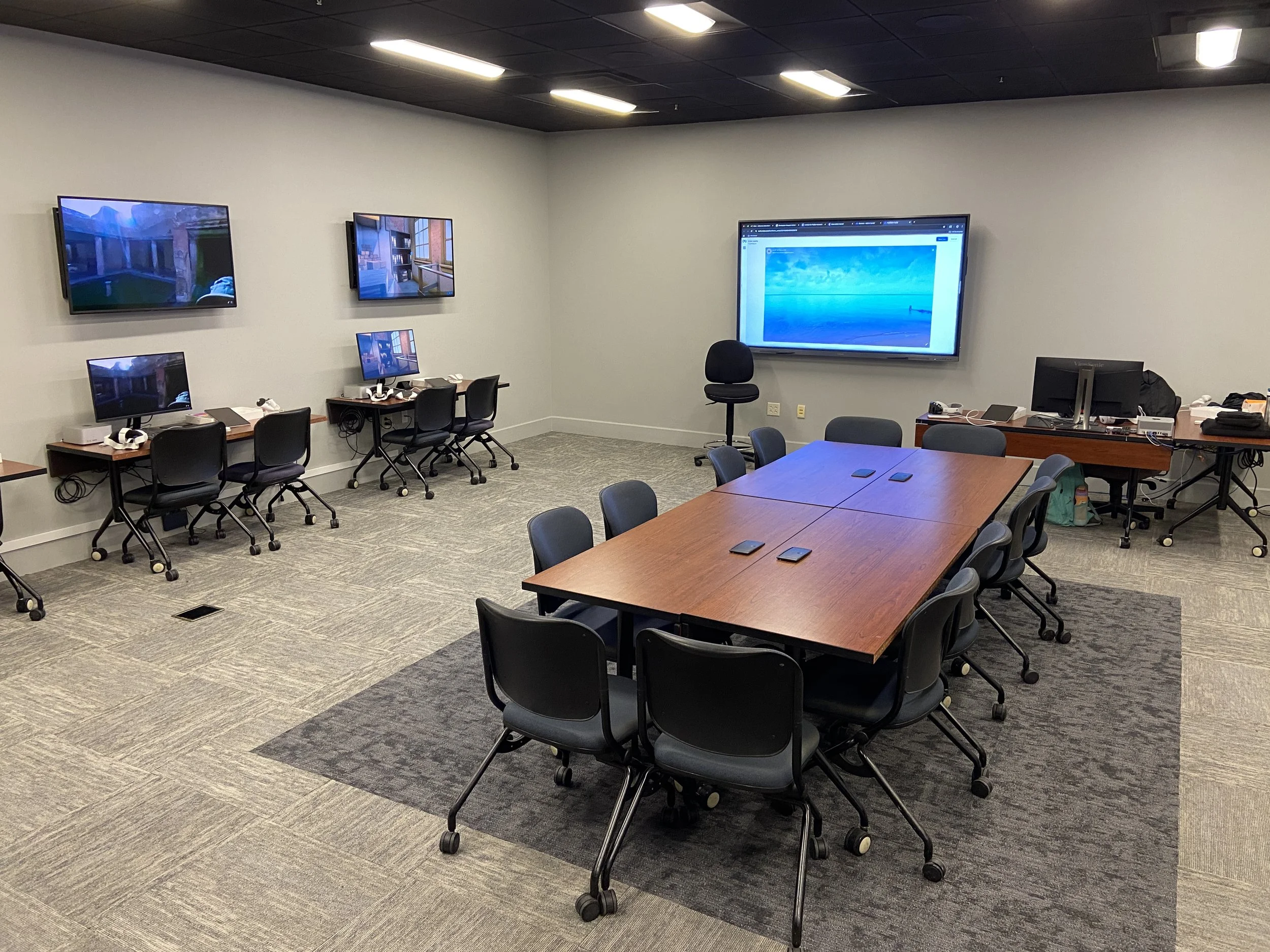
Space: Existing campus room (no renovation required)
Lab Type: Immersive Learning Studio / Themed Environment
Faculty Trained: 6
Projects Produced: 4
Partners: Apple, Insight
Services Provided:
Organizational Assessment
Strategic Roadmap
Lab Design & Theming
Hardware/Software Procurement
Faculty Workshops
Immersive Experience Development
Launch Support & Event Protocols
Overview
Christopher Newport University (CNU), a liberal arts institution in Virginia, recognized an emerging truth in higher education: the future of immersive learning will be shaped by the arts and humanities.
While immersive technologies often live in computer science departments, CNU understood something many institutions are only beginning to realize—technical infrastructure alone does not create meaningful immersive experiences. It is artists, storytellers, historians, designers, musicians, and humanists who give these tools purpose, emotion, and narrative power.
When CNU received donor funding to explore immersive learning, they encountered a challenge that mirrors the experience of hundreds of universities nationwide. They had funding. They had interest. What they lacked was a clear plan for how to move forward.
Through strategic consulting, immersive lab design, faculty development, and hands-on activation—in partnership with Apple and Insight—we helped CNU transform uncertainty into action. In a matter of months, they launched a fully functioning immersive learning lab that now stands as a model for arts-and-humanities-led XR programs across higher education.
Why CNU Chose to Invest in Immersive Learning
CNU’s leadership viewed immersive technology not as a novelty, but as a strategic opportunity to advance teaching, learning, and creative practice. They saw XR as a way to expand expressive possibilities within the arts and humanities, while also giving students future-facing skills that did not require a background in coding or computer science.
At the same time, immersive learning offered a powerful differentiator in an increasingly competitive recruitment landscape. University leaders envisioned the lab as a catalyst for cross-disciplinary collaboration and as a new campus hub—one where experimentation, storytelling, and discovery could flourish side by side.
Like most institutions, CNU was intrigued by XR’s promise but lacked the strategic roadmap, technical confidence, and activation experience needed to turn that promise into reality. Recognizing this gap, an Apple representative connected CNU with our team based on our experience helping universities launch immersive learning environments quickly, intentionally, and cost-effectively.
The Challenges They Faced
CNU’s situation reflected the obstacles faced by many colleges and universities exploring immersive learning.
First, there was no strategic framework in place. Leadership needed clarity around what the lab should be, who it would serve, how it would be used, and how it could be sustained over time.
Second, the project operated under a highly compressed timeline. CNU had $150,000 in funding that needed to be allocated within four months—a schedule that left little room for experimentation, redesign, or missteps.
Third, faculty participants brought widely varying levels of technical comfort. Some had advanced expertise in areas like sound design and digital production, while others openly joked that they struggled to turn on a computer.
Finally, there was the human challenge that accompanies most new technology initiatives: fear. Faculty needed reassurance that this lab would be a safe space to learn publicly, to experiment, and to fail without embarrassment or judgment.
Our Approach
Understanding the Institution
Rather than introducing a prepackaged solution, we began by embedding ourselves within CNU’s existing faculty ecosystem. By participating in faculty meetings and listening closely, we gained a nuanced understanding of departmental goals, expected users, space constraints, faculty capacity, and—most importantly—CNU’s distinctive creative culture.
This groundwork allowed us to design an immersive learning environment that felt authentic to CNU, rather than imported from a technology-first model that might not resonate with the arts and humanities.
“Even though [Ruscella Immersive] provided phenomenal support, it was always our vision… and they were there to help facilitate that.”
Jana Adamitis, PhD
Dean, College of Arts and Humanities
Creating a Strategic Roadmap
Building on these insights, we developed a comprehensive strategic roadmap that guided every decision throughout the project. This blueprint defined the lab’s mission and purpose, outlined spatial and experiential design principles, specified the technology stack, and mapped out faculty training, activation, and long-term sustainability.
The roadmap became the backbone of the initiative, ensuring alignment among stakeholders while providing clarity and confidence at each stage of implementation.
Designing the Immersive Lab
CNU chose to transform the space into what they described as a “time-ship”—a themed environment that visually and emotionally conveyed exploration, imagination, and creative possibility.
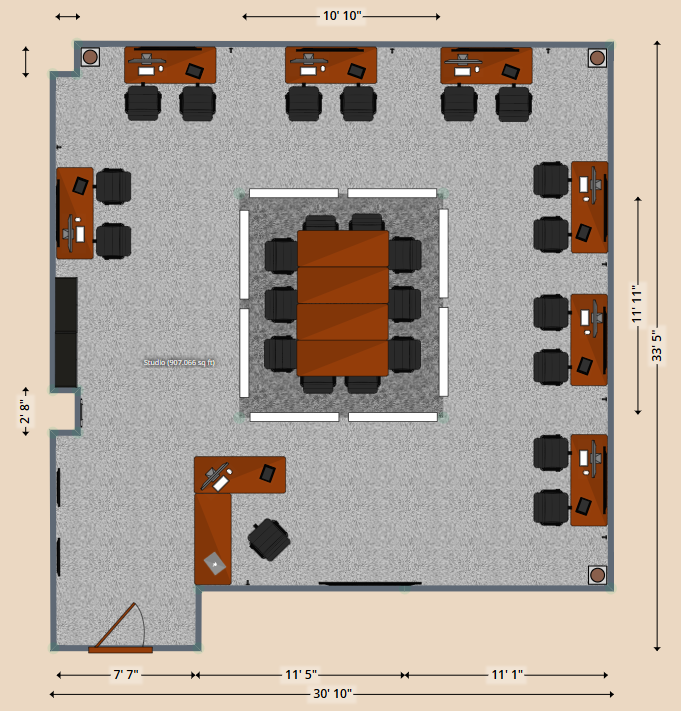
We guided the spatial layout, workstation configuration, thematic elements, and visitor experience flow, ensuring the lab could flex seamlessly between classes, workshops, events, and demonstrations. The result was not simply a functional lab, but an environment that invited curiosity and creative risk-taking from the moment someone entered the room.
Procurement and Build-Out
In close collaboration with Apple and Insight, we oversaw the procurement and installation of XR-ready workstations, 360° video capture equipment, editing and post-production hardware, immersive software tools, and essential supporting accessories.
Each decision was made with careful attention to CNU’s budget, timeline, and real-world teaching use cases. The goal was to deliver a lab that was powerful and future-ready without being unnecessarily complex or overbuilt.
“Consistently throughout the process, it was what I’ll call the cheerleading… Nothing was ever a problem. Everything was good.”
Jana Adamitis, PhD
Dean, College of Arts and Humanities
Faculty Workshops and Project Activation
Six faculty members participated in immersive learning workshops designed to move quickly from orientation to creation. Over the course of two months, these workshops resulted in four fully realized immersive projects.
Faculty entered the process with very different starting points. Those with advanced audio or digital experience accelerated rapidly, while others began with little to no technical familiarity. Within weeks, however, all participants were building immersive content with confidence.
Just as important as the technical progress was a cultural shift. A shared philosophy emerged among participants:
“This lab is a safe place to fail.”
That mantra became foundational, unlocking creativity, collaboration, and sustained momentum.
Launch and Campus Engagement
After learning from early technical challenges during a soft launch, we helped CNU establish repeatable testing and event protocols to ensure reliability and consistency.
With these systems in place, the official lab opening showcased faculty-created immersive projects and generated excitement across campus. Students, parents, prospective applicants, community members, and peer institutions all engaged with the space, reinforcing its role as a visible and inspiring centerpiece of CNU’s academic innovation.
Outcomes
In a remarkably short timeframe, CNU successfully designed, equipped, activated, and launched a fully operational immersive learning lab—measured in months rather than years.
Within the first year, faculty produced four immersive learning experiences that spanned multiple disciplines and reflected CNU’s creative identity. Faculty confidence shifted dramatically, with participants moving from uncertainty to leadership as empowered XR creators.
Perhaps most importantly, the lab established a replicable culture of innovation. It became a failsafe environment where experimentation is encouraged and learning is visible. Since launch, CNU has received growing interest from peer institutions eager to understand how so much was accomplished so quickly.
Why This Matters for Arts and Humanities Programs Everywhere
CNU’s experience demonstrates that immersive learning leadership is not limited to large research universities or engineering-driven programs. Small and mid-sized institutions can lead the movement, and the arts and humanities are uniquely positioned to drive immersive content creation.
Faculty do not need technical backgrounds to succeed in XR. What they need is a clear plan, the right support, and an environment that values curiosity over perfection. With those elements in place, nearly any space on campus can become a powerful immersive learning lab.
Conclusion
CNU entered the world of immersive learning with little more than aspiration and opportunity.
Today, they stand as a national example of what becomes possible when imagination meets structure—an arts-and-humanities-driven XR program that prepares students for the future while inspiring peer institutions to take their own first steps.
Their success is proof that immersive learning does not need to be overwhelming, expensive, or slow. With thoughtful guidance and a clear vision, any university can begin—confidently, affordably, and with lasting impact.
“Major universities are throwing $100 million at buildings, but not $100,000 at students to build something meaningful. Immersive technologies flip that dynamic.”
JJ Ruscella
CEO Ruscella Immersive
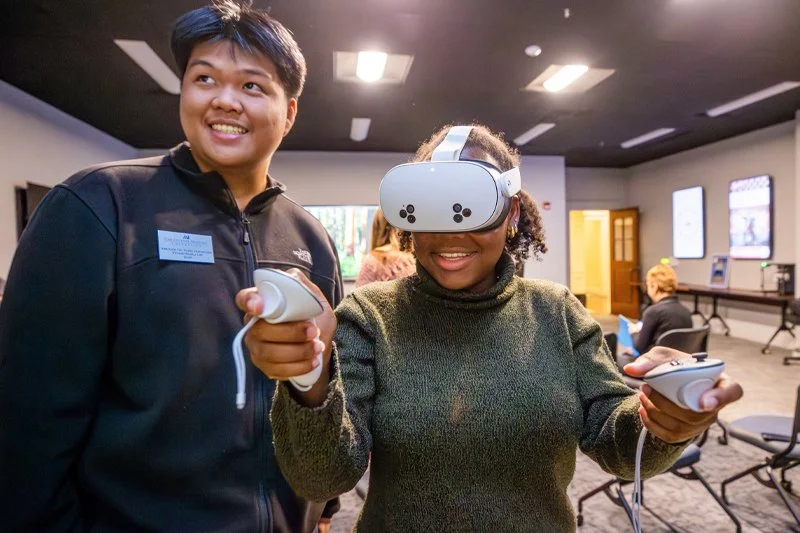
Virtual Reality Lab Delivers World to Campus
Read Christopher Newport University’s official announcement to learn more.
Ready to build your Lab?
Start now by telling us your vision.